


Nikephoros II Phokas, pale death of the Saracens
Updated: Apr 1
A successful general, but an ineffective Byzantine emperor
Nikephoros II Phokas (born 912 in Cappadocia, died 969 CE) was one of Byzantium’s warrior emperors (963-969 CE). He was a prominent military figure, his feats spanning from Crete to Anatolia. He was destined to lead armies, but sadly not to rule an empire. His career trajectory began from his family, the prominent “Phokades” of Cappadocia. From his maternal side, he belonged to the Maleinoi, a powerful Anatolian Greek family.
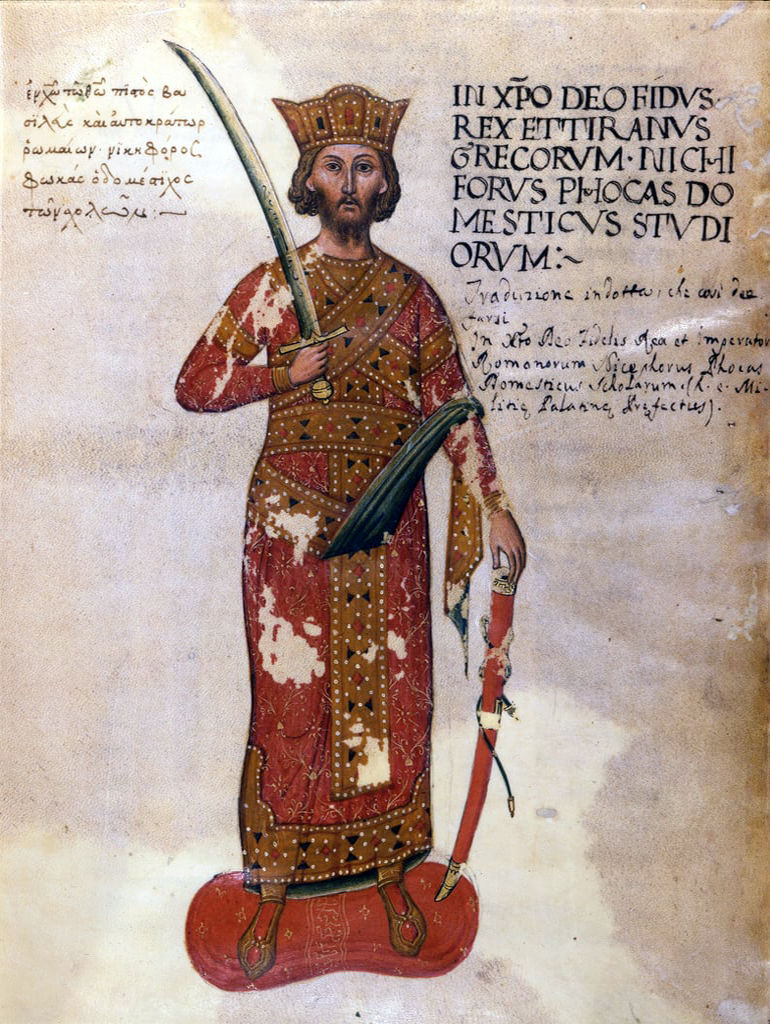
Nikephorus joined the army at a young age and became commander under Emperor Constantine VII. He climbed the ranks quickly to become “Domestic” of the schools, leading the Byzantine armies into several major victories in reconquesting the empire’s lost provinces in Crete, Anatolia and Syria.
The momentum gained from his military victories ensured the support of the army and the people, while his asceticism and piety granted him the support of the church. In his call to take the throne after the death of Romanos II (the son of Constantine VII “Porphyrogenitus”), the ambitious widow, Empress Theofano, would open her arms and the way to the crown, while scheming with his own nephew and his future successor John I Tzimiskes.
Due to his important and commanding military conquests, he was given the nickname, “The Pale Death of the Saracens.” Nikephoros sat in the throne and took up the mantle of the emperor, but the only mark he would leave in Byzantine politics would be that of his blood resulting from his gruesome assassination by the hands of his own nephew and lover of his wife, the empress Theofano. The very people who supported him and subsequently fell out of his favor became part of the conspiracy, while Nikephoros clashed with Byzantine institutions, including the church, and humiliated foreign leaders initiating a chain reaction that would lead Sviatoslav’s blood thirsty Rus to the gates of Constantinople. In a typical “Game of Thrones” scenario, whereby one wins or dies, Nikephoros II Phokas lost not only his life on a cold December night of 969, but also his legacy, with history registering him as a colossal military figure, but a failure of an emperor, nevertheless.
Nikephoros Phokas’ Military Campaigns and Exploits
Nikephoros was one of the greatest military figures known in the Middle Ages, pious to a fault and imbued with the ideology that the Byzantine empire was the “Kingdom of Heaven’s” incarnation. Being a religious zealot with an intense devotion, combined with unique abilities in military leadership, he was the perfect instrument for the empire to take up impossible tasks and succeed where everybody else had failed, starting from the reconquest of Crete, which had been lost to the empire since 824.
The reclamation of Chandax
The reconquest of Greece was not only a matter of prestige for the Byzantine empire, it was a festering wound, since its conquest by the Arabs of Andalusia, as it was transformed to a pirate haven, a springboard for pirates who plagued maritime commerce in the South Aegean and the coastline of Minor Asia. In fact, the capture of Crete was a geopolitical “collateral damage” when Abu Hafs Umar al-Iqritishi was forced to abandon Cordoba, the epicenter of the Arabic Caliphate of Spain due to his clash with Caliph Abu al-As al-Hakam ibn Hisham ibn Abd al-Rahman of the Umayyad dynasty. The fall of Crete was part of a chain reaction which also saw the fall of Sicily along with several islands in the Aegean Sea.
Abu Hafs’ cunningness would leave his mark on the history of Crete, as he chose a location to the North of the island, near the Minoan Knossos to found the capital of his emirate, Chandax, the modern-day Heraklion, taking its name from the Greek word chandaki (meaning ditch or trench), named after the large defensive moat that surrounded it. The city’s importance would resonate up to its siege by the Ottomans during 1645-1669, when the Venetians defended it feverishly and lost it, losing a great part of their influence as well in the Eastern Mediterranean. Chandax was transformed by Abu Hafs into an impregnable fortress, with the Byzantines mounting six campaigns in 140 years, with all of them failing to subdue the island.
It was Nikephoros Fokas’ time to dominate the battlefield and start building his way to the imperial throne. At the age of 47, Nikephoros was entrusted by emperor Romanus II to deal once and for all with Byzantium’s “Cretan Issue”. The fame of his family preceded Nikephoros. His grandfather (also Nikephoros Fokas) had managed to regain control of Southern Italy during the reign of Basil I “Macedonian”, while his father Bardas Phokas had also been appointed as Domestic of the Schools, winning various victories for the empire.
On 13 July 960, the Arabs felt awe while spotting the Byzantine fleet on the Northern side of Crete, ferrying approximately 50,000 strong, as they did not expect that the young Romanus would be so bold, as to attempt an invasion merely months after his inauguration. While disembarking, the Arabs mounted various assaults using cavalry contingents, which all fell under a “rain” of Byzantine arrows and those that survived were trampled by the extra heavy Byzantine Cataphract cavalry.
Soon, though, the mercenaries employed by the empire, especially the Rus, would prove to be its Achilles’ heel, prone to break formation and start looting interminably and without taking defensive precautions. Indeed, when this happened again, Saracen cavalry, screening the troops and seeing the Rus plunged into plundering, attacked them and annihilated not only them, but also the Byzantine forces coming to their aid. Nikephoros was furious after being informed of the ambush that had also cost the life of one of his most valiant generals, but his resolve to conquer the island did not waver.

The siege of Chandax started at the end of July and it would last for 8 months, as the Byzantines were unable to enforce a complete blockade of the city and the besieged would be seamlessly supplied with food and ammunition, while also sending couriers asking Sicely, Egypt and Andalusia for reinforcements, which would never be sent, as the Arabs were too busy fighting against each other. The besiegers along with Nikephoros’ resolve would be tested by harsh winter conditions and the lack of crucial supplies.
Ever the pious, Nikephoros found spiritual refuge to his confessor and his mentor in meditation, Athanasios, a monk, having reluctantly left his hermitage, to provide spiritual council to the Byzantine general. Finally, in mid-February 961, the Byzantine fleet showed up carrying provisions and Nikephoros renewed his assaults against the besieged city. The first two bore no fruit, but the third one taking place on 7 March 961 managed to break though the lines of the exhausted and valiant city defenders. What followed was a dark page in Byzantine history, one that Nikephoros himself was unable to stop. The troops started butchering indiscriminately all Muslim citizens, including old men, women and children, even babies, later found strangled or impaled.
Only the third day did Nikephoros manage to rein in his army, but even so, those who were spared from the sword met the fate of slavery. Following his victory, which was interpreted by Nikephoros as divine intervention, he built the Castle of Temenos (considered a sacred place). He manned it with Armenian mercenaries and set sail with ships full of plunder back to Constantinople. Following the fate of another supreme military figure of the past, though — that of the legendary general Belisarius — he was overshadowed by emperor Romanus.
After being counselled by the venomous eunuch Bringas (and Romanus most probable successor at the time), Romanus denied Nikephoros a victory parade. Nikephoros was glorified in the Hippodrome instead, following behind, not on, the royal chariot. He was subsequently dispatched to Syria, where he would be less of a threat to both Romanus and Bringas.
Nikephoros in Anatolia
It was time for his star to shine in Anatolia, although the ground was already fertile for victory due to Nikephoros’s younger brother, Leo Phokas, and his attacks on the Arab leader Sayf ad-Dawla (Sword of the Dynasty).
Sayf ad-Dawla had conquered Aleppo in 944 making it the capital of his emirate, which was subsequently expanded to include Syria and Northern Mesopotamia, all this having been achieved at the age of 35. In the summer of 960 Sayf al-Dawla had resumed his campaign against Byzantine Anatolia, leading an army of 30,000 strong, while the empire’s campaign against Crete was ongoing.
The Arab general advanced undeterred towards the castle of the Thema of Charsianon, near Syrian Melitene, conquered the city and subsequently butchered its garrison and sold the citizens to slave markets. Leo Phokas was briefed on the dire situation, realizing that he could never triumph over Sayf in open battle. Instead, he chose to ambush his army in one of the northern passes leading to Aleppo, while the Arab army was returning to its base.
Indeed, Leo had managed to read the situation well and in November 961 he achieved total surprise over the emir, after having patiently waited for his army’s main body to enter the straits. Although Sayf fought valiantly his fate and that of his army were sealed and the emir barely managed to escape the battlefield riding a horse of one of his servants with another 300 horsemen. At least half of his 30,000 strong army were slain, while those captured met the same fate of the citizens of Melitene.

By the end of January 962, Nikephoros and his second in command, John Tsimizkes, arrived in Syria, leading a spectacular Byzantine counteroffensive and finishing off what his brother had started. The Byzantine army was no longer outmanned, and the Arabs had already lost the flower of their warriors in Leo Phokas’ ambush.
In just 3 weeks the two brothers would conquer 55 fortified cities in Cilicia, including Anavarzos, Germanicea (modern day Kahramanmaraş) and Flaviopolis, pausing to celebrate Easter and then resuming the advance towards Alexandretta (modern day İskenderun), which surrendered almost without a fight. Several months later, the Byzantine army laid siege on Aleppo, plundering on the very first day the palace of Sayf and subsequently setting it on fire. It remains unclear whether this was done on purpose to provoke Sayf, but if indeed that was Nikephoros’ purpose it worked and the besieged army led by Sayf himself sallied forth in a futile counter-offensive. Sayf, who had managed to escape again, never recuperated psychologically and five years later on 25 January 967 died at the age of 51, after a stroke had left him half paralyzed.
Aleppo fell on 23 December 963 after the Byzantines stormed in and butchered its defenders along with many Muslim citizens. A handful of Arab soldiers locked themselves up in the city’s acropolis, fortifying it, but the fact did not cause any concern to Nikephoros, who left a garrison waiting patiently for the Arabs’ unavoidable surrender. This occurred in December of 969, resulting in the weakening of the Aleppo emirate, which was now an insignificant Byzantine protectorate. On 29 October 969, Antioch fell as well after 332 years of Islamic reign marking officially the end of Nikephoros’ campaign in Anatolia, rightfully granting him the sobriquet the “Pale death of the Saracens”.
The General, who failed as an Emperor
Nikephoros was not interested in waiting for the last defenders of Aleppo to surrender, especially when political developments in the capital were threatening to catch him off guard. On 15 March 963, emperor Romanus II had died, and Bringas’ crowning was impending. The epicenter would rest on the widowed empress Theofano, an innkeeper’s daughter formerly named Anastasia, changing her name before her marriage with Romanus. Ravishing and scheming, a true femme fatale, she had demonstrated early after her marriage that she was not willing to tolerate competition. She manipulated Romanus into locking his five sisters up in a convent, and she savored this victory while she stood watching Patriarch Polyeuktus cutting the hair of the sobering nuns-to-be. Then she made additional-and unopposed-demands to her love-stricken emperor husband that his mother, Helena Lekapene, consort of Constantine VII, be confined to specific chambers in the palace. Whether she had feelings for Romanus or not is irrelevant to the fact that she was highly interested in maintaining her position as empress, choosing to be on the side of Nikephoros Phokas, not Bringas, as the eunuch would be immune to her charms and manipulations.
Nikephoros entered Constantinople victorious following Theofano’s letter inviting him to seize the throne, which he did, after outmaneuvering politically Bringas, who was spared death and was banished instead to his homeland in Paphlagonia where he remained until the end of his life.

Nikephoros’ coronation on 16 August 963 would mark the countdown to his assassination, as albeit a gifted military commander, he had neither the political abilities nor the will to run the Eastern Roman Empire. Secluded, ascetic, introvert, and traumatized by the death of his first wife, Stephano, and their child, he was no match for Theofano’s scheming and charms.
We do not have a clear understanding of what happened to Stephano, but the Byzantine 11th-century historian, John Skylitzes, claims that Nikephoros had a son, Bardas, who had died at a young age after being mortally wounded with a spear, perhaps while playing. After his death, Nikephoros abstained from consuming meat. Skylitzes doubts it was an honest act or an affectation to impress, but given Nikephoros' conceptualization of life and religion, this was most probably an act of true penance, stemming from the Orthodox Church's particular underscoring of a person's evolution by surviving God's trials without giving in to doubt and despair.
Clashes with the Church
And yet, even though he was so devout, his clumsy manners made him prone to conflict with the very institutions that had catalyzed his crowning, such as the church. The first clash occurred on his wedding day to Theofano, with Patriarch Polyeuktus waiting for the right moment to embarrass him publicly. The church leader believed the emperor should have performed penance for his first marriage before arranging a second. For this infraction, Patriarch Polyeuktus banished Nikephoros from the church’s inner sanctum for a year, which, for a devout man like Nikephoros, struck a major blow. Nikephoros would never forget “the bloody nose”, already agitated by the church’s hoarding of riches and property, culminating in the 200 years since Constantine V Copronymus had passed legislations to curtail the church’s gigantic influence and property.
Typically lacking diplomacy and the will to compromise, Nikephoros forbid all donations towards churches, monastery and the clergy along with the founding of new monasteries and other ecclesiastic institutions. Furthermore, by royal decree no clergyman could be crowned bishop without the emperor’s approval. Considering the church’s dominion in the Byzantine society, coupled with Nikephoros’ lack of political savvy to bring about any major changes, those clumsy moves would be part of sawing off the branch he was sitting on.
Dissatisfaction at home
The church, though, was only one of a multifront clash Nikephoros had engaged himself in. He was heavily criticized for maintaining a high number of troops, a fact that would be unnecessary if he wasn’t such a “warmonger”. Indeed, the same people who cheered for his victories were now accusing him of being responsible for stray soldiers who were attacking helpless citizens so much so that they were afraid of going out when the sun went down.
The dissatisfaction was intensified during the winter of 967 as the poor wheat harvest skyrocketed the price of bread. This was not Byzantium’s first poor harvest with several previous emperors taking measures to alleviate the citizens, either by offering money or other tangible means and measures, but Nikephoros chose instead to do nothing, while rumors were circulating that he was giving wheat to his soldiers only. Although those rumors cannot be corroborated, they were-at best-part of a disinformation campaign waged by the enemies of the emperor to turn the mob against him, and they were successful.
The fear and hostility culminated during the Easter Sunday of 967 when a brawl broke out between Armenian soldiers, who were part of the imperial guard, and Thracian seamen resulting in a general clash in which many citizens lost their lives. During the afternoon of the same day, races and festivities had been scheduled in the hippodrome, as in every Easter. The shadow of the morning’s clashes, though, was looming over the hippodrome spectators who feared of another Nika riot kind of suppression.
Nikephoros, though, was oblivious to the fears of his own people and was most likely planning to reenact battles, which were included in the spectacles at the hippodromes. When the citizens, though, saw the soldiers on the Arena, they panicked and moved massively towards the exits, trampling and asphyxiating each other. It was gradually perceived that despite everything the soldiers were remaining on the arena and the emperor looked perplexed as to why the panicked crowd were trying to evacuate the hippodrome.
Even though the crowd eventually relaxed, they still held the emperor responsible for the hippodrome deaths, and two months later on the Ascension Day, while Nikephoros was returning to the palace, relatives of the hippodrome victims surrounded him and started attacking and swearing at him, throwing rocks, bricks and even arrows. The angry crowd was going to lynch the emperor, who was saved after the intervention of his imperial guard. As a result, fear and melancholy settled in the heart of Nikephoros who was further detaching from reality and ended up abandoning his bed to sleep on the floor on a panther’s pelt, a return of his ascetic ways.
The death of his father, Bardas Phokas, was most likely the point of no return for Nikephoros’ fragile psychology. This event was coupled with the appearance of an unknown monk, who warned him that he would die on the third month of the coming September. Nikephoros deteriorated; he came to believe that the rumors, the random fights between generals, the events at the hippodrome, and the monk’s message were part of an undeclared war against him, meant to cripple him psychologically and turn the people against him. Unfortunately, it was something that Nikephoros had brought upon himself when he chose to clash with everybody both within and outside of the empire.
Trouble at home, trouble abroad
The handling of foreign affairs was just as clumsy as the domestic, and while Anatolia had been a region of immense success, other regions like Sicily, South Italy, and the Balkans were either neglected or sabotaged by the emperor’s obstinacy. In Phokas’ reign, Sicily was almost completely held by the Arabs except for the fortified city of Rometta. When the Arabs laid siege to the city, Nikephoros sent reinforcements during the fall of 964, but they were defeated on land and sea during the naval battle of the Straits in 965, near Messina. This forced the empire to relinquish the entire Sicily to the Arabs.
South Italy fared slightly better and it was the primal focus of emperor Otto I of the Holy Roman Empire. Otto I (912-973) — also known as Otto the Great — had the vision of uniting the two empires through the marriage of his son with one of the princesses of the Byzantine court. To this end he sent a diplomatic mission to Constantinople, but a series of misunderstandings coupled with Nikephoros’ suspicion sabotaged the process to such an extent that led a furious Otto to command an attack against the Byzantine Apulia. The attack was unsuccessful and Otto once more made a move to approach the Byzantine court via his envoy Liutprand, the bishop of Cremona. He was received coldly and hostilely, as Nikephoros regarded him a heretic, even more dangerous than the rest of the Franks, due to the fact that he was speaking Greek. Nikephoros believed that Liutprand was an instrument of a barbarian German ruler who had failed to acknowledge that there was only one Roman empire and its capital was Constantinople, and having dared to attack the Byzantine possessions in Italy. Liutprand remained in Constantinople for fourth months enduring patiently insults and abuses, until the two empires were at war again, resulting in no tangible territorial gains.
The worst possible outcome was brought about in the Balkans, with Nikephoros being the incarnation of Murphy’s law. In 967, Bulgarian envoys arrived in Constantinople to collect the annual tribute imposed by a humiliating peace treaty between the Bulgarian Simeon I and Romanos I Lekapenos. The concessions of the treaty included the marriage of the emperor’s granddaughter, Maria Eirini, with Tzar Peter’s son, Petros. The treaty was renewed when Romanos II held the throne, who did not see a reason why this diplomatic status quo should be disturbed, Nikephoros, though, begged to differ. A furious Nikephoros lashed out at the envoys, insulting them and characterizing them as a race of filthy beggars, slaves and sons of dogs, ruled by a leader who dresses in animal pelts. He subsequently ordered their flogging before sending them back to the Bulgarian capital of Preslava and then declared war on the Bulgarian Tzar, capturing a series of fortresses.

Despite the victories, he was reluctant to advance to the mainland, where his troops would certainly meet their doom in the country’s unhospitable northern terrain, choosing to make peace instead, the terms of which included the Tzar’s sons being taken hostage. Geopolitically myopic and impetuous as he was, he proceeded into the unthinkable, inviting the prince of Kiev Sviatoslav to subdue the Bulgars on his behalf, for a hefty price, a deed that he would later lament, but it was already too late. The Rus were far more powerful than the weakened Bulgars, who served as a buffer zone for a small price paid by the Byzantines.
The chain reaction of events were concluded with the death of Tzar Petros, who was succeeded by his insignificant son Boris and Sviatoslav’s mother, the only person who could keep the savage Rus warlord at bay. Indeed, following the death of his mother, Sviatoslav in charge of a large army comprising Rus, Hungarians and Pechenegs crossed the Danube and literally swallowed the Bulgarian kingdom, with Boris and his family being sold as slaves. The only city that resisted them was Philippopolis (the modern city of Plovdiv), but that further infuriated Sviatoslav, who impaled 20,000 citizens once he managed to capture it. After ravaging and raiding every corner of the Bulgarian kingdom, he made camp at the border with the Thema of Thrace, in the beginning of the winter of 969, obviously intending to mount an attack on Constantinople in the spring to come.
The bungling of the Bulgarian situation was the last straw in a series of Nikephoros’ major blunders. It became a death sentence that he himself, albeit unintentionally, had signed.
The Emperor must Die
The stage was set for the actors operating in the shadows to get rid of Nikephoros, who was now loathed by the people, the church and even by ex-comrades in arms, who had been sidelined, like his nephew and once second in command and Domestic of the schools, John Tsimizkes. Tsimizkes was definitely a man who could hold a grudge, ambitious as he was, he had started an affair with the empress Theofano, being her partner in machinations, selected as the hand to strike the final blow.

The first step in the mechanations was for Tsimizkes to be called back to Constantinople, as he was exiled to his family estate, due to his disagreements with the emperor. The task was simple enough for the empress, who convinced Nikephoros that John was “no Bringas” and his rightful position was in Constantinople. Nikephoros reluctantly accepted under the condition that John would remain at his family manor in Chalcedon (on the Asian side of Bosporus) and that he would be allowed entry in Constantinople under special circumstances. It was clearly not what the lovers had hoped for, but still better than nothing and the assassination date was set on 10 December 969.
In the afternoon of the 10th, the conspirators, dressed as women with their swords hidden underneath their long women’s clothes entered the palace from the women entrance and were hidden by Theofano in small chambers until the hour of assassination was at hand. The scheme was nearly foiled when one of them, with a sudden change of heart, notified an imperial advisor of the mortal danger the emperor was in and that the conspirators were already hiding within the palace. Nikephoros, in turn, dispatched one of his most trusted advisors, the eunuch Michael, to check the palace, but it was nothing that Theofano could not handle, as she persuaded Michael to enter the conspirators’ side and report back to the emperor that the rumors were just a false alarm.
There were two more problems. The first one was that Tsimizkes had to cross the Bosporus Strait under adverse weather conditions and the second was that the emperor’s chambers had to be left unlocked. Theofano made sure once more to deceive the emperor, saying that she was going to visit the chambers of the two Bulgarian princesses, who were guests in the palace and that would not take long, therefore she would leave the chambers unlocked. The ever naïve Nikephoros believed her again and went to the library to study theological texts and to pray. After an hour and without his wife having returned, he went back to the bedroom to sleep on the panther’s pelt.
Meanwhile, Tsimizkes was struggling to cross the Bosporus Strait in the middle of a snowstorm. In the end, he managed to reach the palace, climbing to the emperor’s chambers. When the conspirators entered the chambers, they were shocked as the emperor was not to be found, and instead they thought they had been intentionally misled by the emperor’s imperial guards and had walked right into a trap. The eunuch then showed them the exact spot where the emperor was sleeping, on the ground, on the panther’s pelt. By then, Nikephoros had been woken up by the noise and tried to react. What followed next was not just dispatching someone who had failed in his duties. It was a hate crime, a brutal execution, stemming from pure hatred. It was the inhumane treatment of a man who had once been a legend among the Byzantine troops.
One of the conspirators hit Nikephoros with all his force intending to finish him off with one blow. Decreased visibility, though, made him miss and cut the ill-fated emperor diagonally in the face. Nikephoros began praying, but the assassins’ hands were not stayed. The emperor’s guards stormed in, but they were too late and Nikephoros had already been violently murdered by multiple hands. While this was occurring, other Tsimizkes’ supporters roamed the city, shouting: “John! Augustus and King of the Romans”. Troops loyal to Tsimizkes had already captured main points in the city to suppress any potential reactions by Nikephoros’ supporters.
Nikephoros Fokas was a superb military figure, a pious man, a zealot, possessing all those traits which could not be translated into successful political leadership, albeit the glory it was bestowed on him as a military commander. Furthermore, his harsh, ascetic nature and character, the lack of geopolitical depth perception, his blind love for Theofano, and his tendency to alienate those close to him, like Tsimizkes, made him a victim of machinations by his enemies. Due to these qualities, the enemies of Nikephoros had no trouble in turning his own people against him, through cheap tricks of mass manipulation. By far, his worst, almost unforgivable mistake, was the invitation of the Rus, led by Sviatoslav, to the gates of the capital, a burden which now weighed his assassin, nephew and successor John Tsimizkes. Tsimizkes, for his part, would be an excellent warrior emperor as well, giving Theofano a taste of her own poison, but despite his gifted ruling, he would never be able to shake off his own guilt primarily, stemming from the brutal death of his own uncle, no matter how unpopular Nikephoros Phokas was and no matter how intensely his death was longed for.
Alexandros Boufesis has an Msc in International Security Studies (London Metropolitan University) and a PgC in Counter-Terrorism (St Andrews). Alexandros has worked for many years as a Freelance article writer and an investigative journalist covering topics on military history, geopolitics and defense. He is the author of "Operations Odyssey Dawn and Unified Protector 2011 NATO and the Air War over Libya, 2011-2020" (Operations Odyssey Dawn and Unified Protector 2011 | Africa@War | Helion & Company) and "China's Military Modernization, Assessing China's Weapons and Strategic Reach in the early 21st Century China's Military Modernization | Asia@War | Helion & Company
Primary Sources
The Chronicle of John Skylitzes: A Synopsis of Byzantine History, 811-1057, translated from Greek by John Wortley (New York, 2010), Internet Archive.
Further Reading
Anon, “Who is Nicephoros Phokas?”, Phokas Cave Suites, accessed 14 February 2026
John Carr (2015): “Fighting Emperors of Byzantium” (South Yorkshire: Pen & Sword).
Juliane Romane (2015): “Byzantium Triumphant, the Military History of the Byzantines 959-1025” (South Yorkshire: Pen & Sword).
Richard Cavendish (2013): “Nikephorus II Phokas, crowned emperor of Byzantium”, History Today, accessed 14 February 2026.
Γιάννης Χρονόπουλος (2023): “Νικηφόρος Β’ Φωκάς, Βυζαντινοί Αυτοκράτορες-Στρατηγοί” (Αθήνα: Historical Quest).
Γιάννης Χρονόπουλος (2009): “Νικηφόρος Φωκάς, ο Λευκός Θάνατος των Σαρακηνών” (Αθήνα: Περισκόπιο).

Comments